
Last checked: September 3, 2026. Immigration documents can vary by status of stay and personal circumstances, so use the official links at the end for your final check.
If you will live in Korea for more than 90 days, one of your first administrative tasks may be foreign resident registration. The plastic ID issued after registration is officially called a Residence Card. Many residents, employers, and even older English documents still call it an ARC or Alien Registration Card.
The important distinction is simple: you apply for registration, and the card is the proof issued afterward. This guide covers the common process, the documents most applicants start with, and the points that must be confirmed for your own visa.
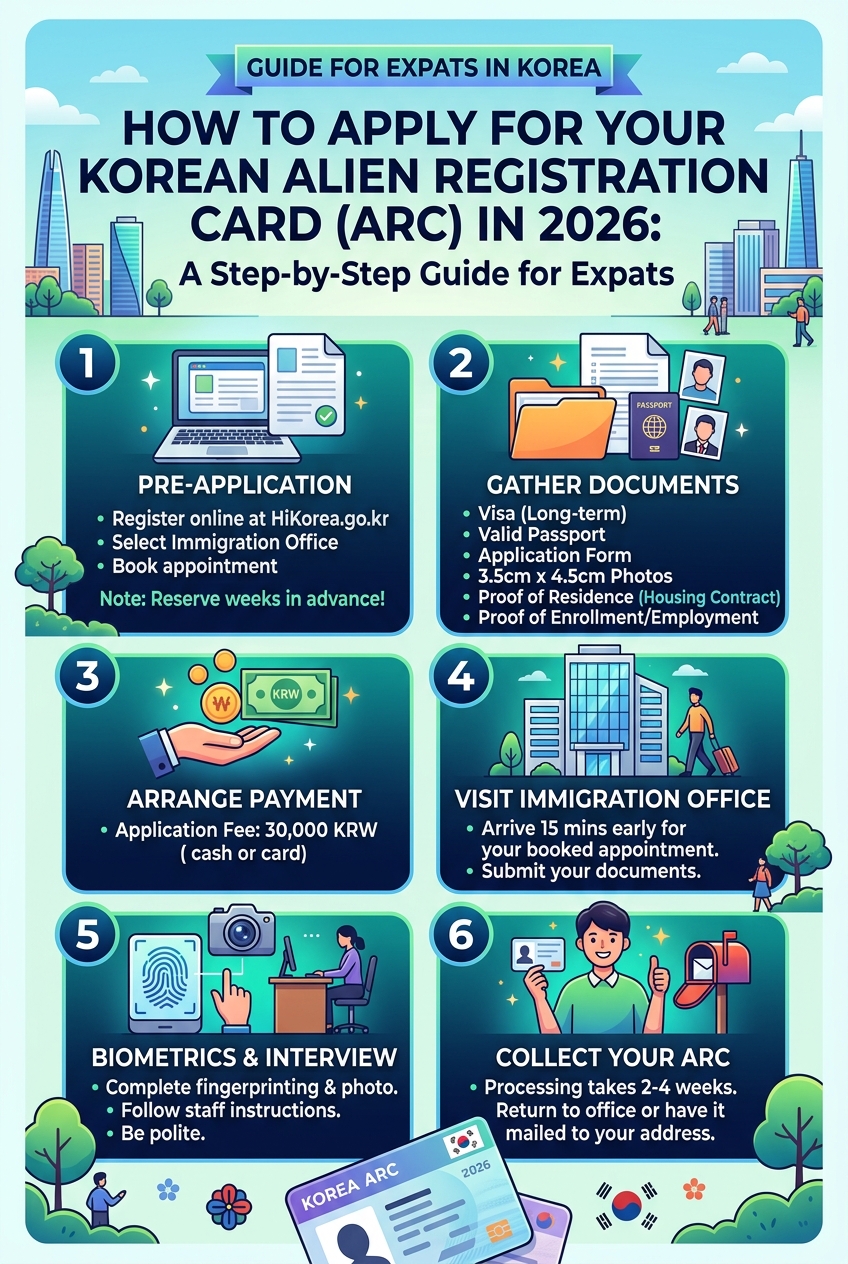
Residence Card application at a glance
| Question | General rule |
|---|---|
| Who registers? | A foreign national intending to stay in Korea for more than 90 days, unless a statutory exception applies. |
| Deadline | Within 90 days of entry. If status of stay is granted or changed in Korea and the person will stay more than 90 days, registration is handled when that permission is granted. |
| Where? | The immigration office or branch with jurisdiction over the applicant's Korean residence. |
| Reservation | Most applicants should reserve a visit through HiKorea. A reservation is only an appointment; it is not proof that the application was filed. |
| Card fee | 35,000 won for a Residence Card issued from January 1, 2025. Other service or delivery charges may be separate. |
1. Confirm your deadline before looking for an appointment
Article 31 of Korea's Immigration Act sets the core rule: a foreigner who will remain for more than 90 days must register within 90 days after entry. HiKorea lists exceptions, including certain diplomatic, official, and agreement-status holders. A person under 17 may not receive a physical card immediately, even though immigration records may still apply.
Do not calculate the deadline from your first workday, school orientation, lease date, or appointment date. Use your entry and status history. If you changed status inside Korea, or have an unusual category such as F-4, F-5, diplomatic status, or a Korea-born child, ask 1345 which registration or residence-report procedure applies.
2. Find the office responsible for your home address
Jurisdiction follows your place of residence, not necessarily your workplace or university. Two people employed by the same company can therefore use different immigration offices. HiKorea has an official immigration-office jurisdiction search; the 1345 automated menu also provides office and jurisdiction information.
Confirm the address first, especially if an employer, school, friend, or family member provides your accommodation. The address on the application should be supported by the residence document you submit.
3. Reserve the visit on HiKorea
Use the official HiKorea visit-reservation page. It offers member and non-member routes. Select the correct office and the service for foreign resident registration, then save the reservation confirmation.
HiKorea gives two deadline warnings that are easy to miss:
- The reserved visit date must fall before the legal registration or stay deadline.
- If no appointment is available before that deadline, HiKorea instructs the applicant to visit the jurisdictional immigration office before the reporting period ends.
Booking a late appointment does not extend a deadline, and the booking itself is not an accepted application. This is why it is worth checking appointment availability soon after arrival.
4. Start with the common document set
HiKorea's foreign-registration page lists the following common items:
- Passport, plus a copy of the biographical page and visa page
- Integrated Application Form (Report Form), officially Annex Form No. 34
- One color photograph, 3.5 cm by 4.5 cm
- Proof of residence
- Documents required for the applicant's status of stay
- The applicable fee
Bring originals as well as clear copies when possible. Names, passport numbers, and addresses should agree across the documents. If a document was issued outside Korea, confirm in advance whether a Korean translation, notarization, consular authentication, or Apostille is required.
5. Use proof of residence that explains who provides the home
HiKorea gives examples such as a lease, confirmation of accommodation, notice of upcoming stay expiration, or utility-payment receipt. Which one works depends on the housing arrangement.
| Housing situation | What to prepare first |
|---|---|
| Lease in your name | The complete lease showing your name and the Korean address. |
| Employer or university housing | A confirmation of accommodation and any provider or property document the office requests. |
| Living with another person | A confirmation from the accommodation provider, plus supporting identification or occupancy evidence requested for that case. |
A phone photo of a partial lease or an informal message from the host may not establish the address or the provider's right to offer the accommodation. Ask 1345 what supporting document is needed if your name is not on the lease.
6. Check the visa-specific list shortly before the appointment
The common checklist is not the final checklist. HiKorea publishes additional documents by status of stay: for example, D-2 students may need proof of enrollment, D-10 applicants a job-seeking plan, and employment categories commonly need documents from the sponsoring workplace. E-2 and some teaching cases can have additional medical or criminal-record requirements.
These details change and the office may add or waive documents after reviewing an individual case. Use the HiKorea foreign-registration document page and the current status-of-stay manuals, then call 1345 if the pages do not answer your situation.
Do not assume HR or a university has filed the application merely because it collected documents. Ask whether it is arranging the appointment, acting as an authorized representative, or only helping you prepare.
7. Make sure the photo meets the official standard
The official size is 3.5 cm × 4.5 cm. HiKorea says it should be a front-facing color photo taken within the past six months, on a plain white background without a border. The image should be clear, unaltered, and free of facial shadows; the eyes should face forward, the mouth should be closed, and sunglasses or colored contact lenses are not accepted.
A Korean photo studio can usually recognize the phrase 외국인등록증 사진. Tell the studio you need a physical print for foreign resident registration rather than only a digital passport-photo file.
8. At the immigration office
Arrive with your passport, the completed application, photo, residence evidence, visa-specific papers, payment method, and reservation confirmation. Keep the receipt or application confirmation after filing. If the officer requests another document, note the exact document name, deadline, and submission method rather than relying on memory.
Processing time is not identical everywhere. Ask the officer how the card will be delivered or collected and how you can check progress. Avoid promising an employer, bank, or phone provider a card date until the office gives you an estimate.
What changed: the IC card and mobile Residence Card
The Ministry of Justice raised the physical Residence Card issuance fee to 35,000 won from January 1, 2025 when it introduced a card with an embedded IC chip. An older valid card does not need replacement solely because the design changed.
Since January 10, 2025, registered foreign residents aged 14 or older can also obtain a Mobile Residence Card on an eligible smartphone registered in their own name. The Ministry says it has the same legal validity as the physical card. A person with the IC card can use the official Mobile ID app; an older-card holder can visit immigration for QR issuance. Availability at a particular bank, website, or private business can still depend on that provider's system.
After you receive the card
Registration creates continuing reporting duties. The Visa Navigator says a registered foreign resident must report a move within 15 days; F-4 holders have a separate 14-day residence-report rule. A change can be reported at the local government office near the new residence, the immigration office with jurisdiction over the new residence, or through HiKorea where the online service is available.
A Residence Card also does not give permission to work outside the activities allowed by your status of stay. Check first if you change or add a workplace, take freelance work, or begin a side job.
When to call 1345
The Immigration Contact Center answers at 1345 in Korea. The official service page lists weekday counseling from 09:00 to 22:00; after 18:00, Korean, English, and Chinese are available. From overseas, use +82-2-1345 or +82-2-6908-1345~6.
Have these details ready: nationality, current status of stay, entry date, expiry date, Korean home address, and housing arrangement. A useful question is: “For my first foreign resident registration under [status], at [address], what is my deadline, which office has jurisdiction, and which additional documents are required?”
This article summarizes public immigration guidance and is not individualized legal advice. The immigration office decides the documents and result for each application.
Related guides
Official sources
- National Law Information Center — Immigration Act, Article 31
- HiKorea — Who Must Register and When
- HiKorea — Foreign Registration Documents
- HiKorea — Residence Card Photo Standard
- HiKorea — Visit Reservation Guide
- Korea Immigration Service — 35,000 Won Residence Card Fee
- Korea Immigration Service — Mobile Residence Card
- Korea Immigration Service — Immigration Contact Center 1345


0 Comments