
How to Get Your Korean Residence Card ARC in 2026: Step-by-Step Guide for Foreigners
Moving to South Korea is exciting, but there is one document that can quickly become the center of your new life here: your Korean Residence Card, commonly still called the ARC, or Alien Registration Card.
If you plan to stay in Korea for more than 90 days, you will usually need to complete foreigner registration and receive a Residence Card. This card is more than just an ID. It is often needed for opening a bank account, signing up for a Korean phone plan, verifying your identity online, using delivery apps, registering for services, and handling daily life more smoothly.
The process can feel confusing at first because requirements may vary depending on your visa type, address, school, employer, or local immigration office. But once you understand the basic flow, it becomes much easier. This guide explains the practical steps, common documents, useful tools, and mistakes to avoid when applying for your Residence Card in Korea.
Important note: Immigration rules, forms, fees, and required documents can change. Always confirm the latest information through the official HiKorea website or by calling the Korea Immigration Contact Center at 1345 before your appointment.
Why Your Residence Card Matters in Korea
Your Korean Residence Card is one of the most important documents you will receive after arriving in Korea. Many everyday services are connected to identity verification, and that verification often depends on your Residence Card and a Korean phone number registered under your name.
With your Residence Card, life in Korea becomes much more convenient. You may need it for:
- Opening a regular Korean bank account
- Getting a postpaid mobile phone plan
- Verifying your identity for apps and websites
- Using online shopping, delivery, and booking platforms
- Signing rental, school, work, or membership documents
- Handling local administrative procedures
Without it, you can still live temporarily in Korea, but many services may feel limited or inconvenient. That is why applying early and preparing correctly matters.
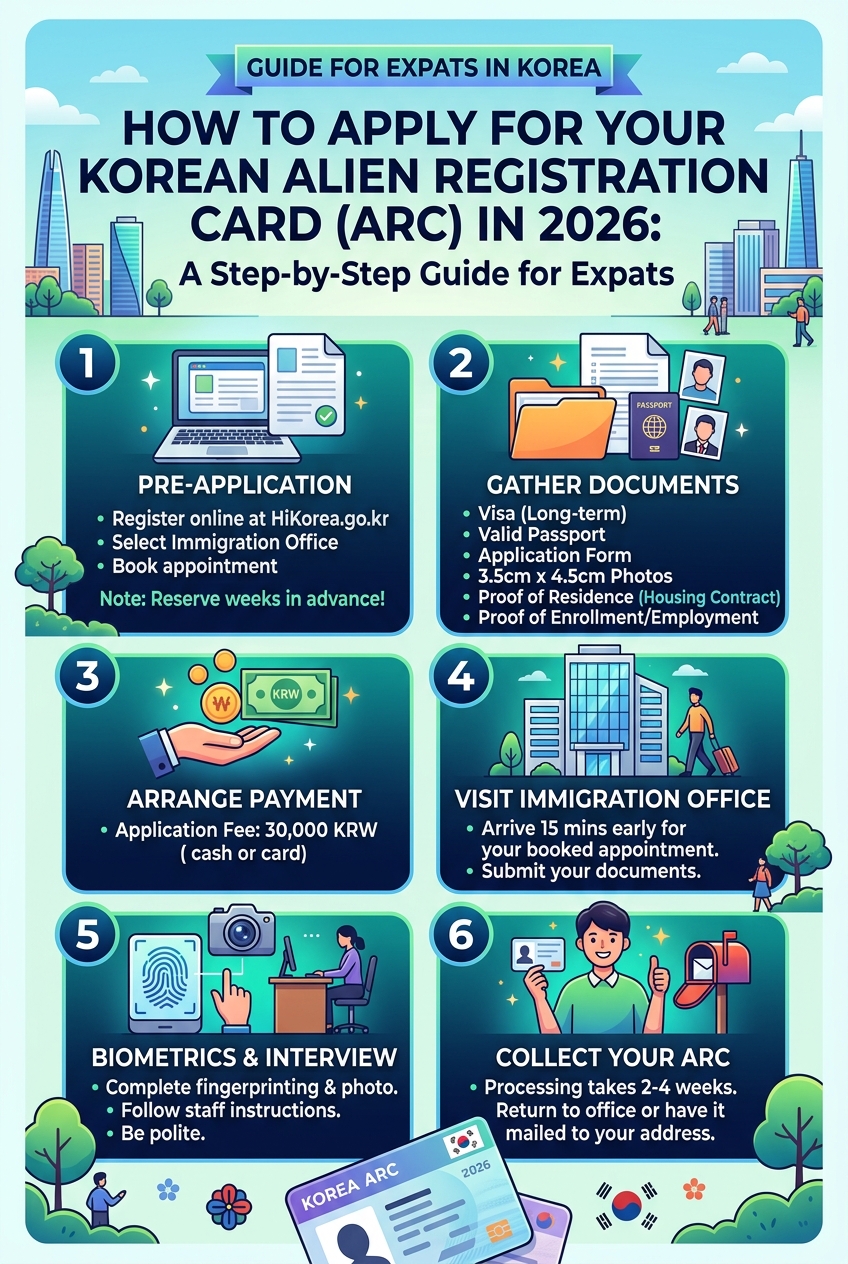
Step 1: Book Your Immigration Appointment on HiKorea
The first practical step is making a visit reservation through HiKorea. In most cases, you should not simply walk into an immigration office without an appointment. Reservation availability can fill up quickly, especially in busy areas such as Seoul, Busan, Incheon, Suwon, and university districts.
Foreigners who need registration are generally expected to apply within 90 days of arrival. However, do not wait until the end of the 90-day period. Book your appointment as soon as you have a confirmed Korean address and know which immigration office has jurisdiction over your residence.
How to Make a HiKorea Reservation
- Go to the official HiKorea website.
- Change the language to English if needed.
- Select “Visit Reservation” or “Reserve Visit.”
- Choose the correct immigration office based on your Korean address.
- Select the purpose related to foreigner registration or residence card application.
- Choose the earliest available appointment that works for you.
- Save or print your reservation confirmation.
The immigration office is usually assigned by your residential address, not by personal preference. For example, two people living in different districts of Seoul may need to visit different immigration offices.
Jin’s 8282 Tip: Book first, then prepare your documents. If you wait until every document is ready before booking, you may lose valuable time.
Step 2: Prepare the Basic Documents
Your required documents depend on your visa type, but most applicants need a basic set of documents. Prepare both originals and copies whenever possible. Immigration officers may ask for additional documents depending on your case.
Common Documents Many Applicants Need
- Integrated Application Form: Usually available through HiKorea or at the immigration office.
- Passport: Bring your original passport.
- Copy of Passport Information Page: Make a clear copy before your visit.
- Visa-related documents: This depends on your visa type.
- Passport-style photo: Usually 3.5 cm x 4.5 cm with a white background, taken recently.
- Proof of residence: A housing contract, dorm confirmation, or accommodation confirmation form may be required.
- Application fee: Fees can change, so confirm the latest amount before your appointment.
For the photo, the easiest option is to visit a local photo studio in Korea and ask for an “외국인등록증 사진” or “Residence Card photo.” This helps reduce the risk of rejection due to size, background, or format problems.
Step 3: Check Visa-Specific Requirements
This is the part where many applicants make mistakes. The basic documents are not always enough. Your visa type may require extra documents from your employer, school, spouse, or housing provider.
For E-2 Visa Holders
If you are in Korea as a foreign language instructor, you may be asked to prepare documents such as:
- A copy of your employment contract
- Your employer’s business registration certificate
- Documents related to your school or academy, if requested
- Proof of residence
Your employer or school should help provide company-related documents. Ask early so you are not trying to collect paperwork the day before your appointment.
For D-2 Student Visa Holders
International students may need documents such as:
- Certificate of enrollment or admission-related document
- Proof of tuition payment, if required
- Dormitory confirmation or housing contract
- Passport and visa-related documents
If you live in a university dormitory, your university’s international office can usually guide you on the correct residence confirmation document.
For F-6 Marriage Migrant Visa Holders
Marriage migrant visa applicants may be asked for family and marriage-related documents, which can include:
- Marriage relationship certificate
- Korean spouse’s basic certificate
- Resident registration copy related to the household
- Copy of the Korean spouse’s identification
- Proof of residence
Because family-related documents can be sensitive and must be issued correctly, it is best to confirm the latest checklist through HiKorea or the 1345 immigration hotline before your visit.
Step 4: Prepare Proof of Residence Carefully
Proof of residence is one of the most common reasons applicants experience delays. Immigration needs to confirm where you actually live in Korea. The correct document depends on your housing situation.
If You Signed Your Own Lease
Bring a copy of your housing lease contract. The address on your application should match the address on the contract.
If Your School or Company Provides Housing
You may need a confirmation of accommodation or residence form signed by the housing provider. You may also need supporting documents from the company, school, or person providing the accommodation.
If You Are Staying With a Friend or Family Member
You may need a signed accommodation confirmation form, a copy of the host’s ID, and proof that the host has the right to live at that address. Requirements may vary, so check before your appointment.
Jin’s 8282 Tip: If your housing situation is not simple, call 1345 before your appointment and ask exactly what documents are needed for your case.
Step 5: Visit the Immigration Office
On your appointment day, arrive early. Immigration offices can be busy, and it may take time to find the correct counter, pay the fee, or prepare revenue stamps if required.
What Usually Happens at the Office
- Check in for your appointment: Show your reservation confirmation if requested.
- Pay the application fee: Depending on the office, payment may involve a payment machine, revenue stamp, bank counter, or other method.
- Wait for your number: Watch the electronic display carefully.
- Submit your documents: Give your documents to the immigration officer when called.
- Answer basic questions: The officer may ask about your address, school, employer, or visa status.
- Complete biometric registration: Fingerprints and a digital photo may be taken.
- Receive your application receipt: Keep this paper safe until your card is issued.
Your application receipt is important. It proves that you applied and may include information you need later. Do not throw it away.
Step 6: Wait for Your Residence Card
Processing time can vary depending on the immigration office, season, and your application status. In many cases, it may take several weeks. The officer or receipt may give you a better estimate.
You may be able to choose between picking up the card in person or receiving it by registered mail. Mail delivery is often more convenient, but you should confirm the fee, delivery method, and address carefully at the office.

Useful Apps and Tools for the ARC Process
A few simple tools can make the Residence Card process much easier, especially if you are not comfortable reading Korean documents yet.
- Papago: Useful for Korean-English translation, especially signs, forms, and short notices.
- Naver Map or Kakao Map: Better than Google Maps for many local directions in Korea.
- HiKorea Bookmark: Save HiKorea on your phone for reservations, forms, and status checks.
- Phone Scanner App: Scan your passport, visa documents, contract, application form, and housing documents before your visit.
- Physical Document Folder: Keep originals and copies separated so you can find everything quickly at the counter.

Common Mistakes to Avoid
Most Residence Card problems are not caused by complicated laws. They usually happen because of missing documents, wrong addresses, late reservations, or small details that were not checked in advance.
1. Booking the Appointment Too Late
Do not wait until the last minute. Appointments can fill up quickly, especially during school intake seasons and busy relocation periods.
2. Going to the Wrong Immigration Office
Your office is normally based on your Korean residential address. Always confirm the correct jurisdiction before booking.
3. Bringing the Wrong Photo
Photos with colored backgrounds, shadows, casual poses, or wrong sizing may be rejected. A Korean photo studio is usually the safest option.
4. Not Preparing Proof of Residence Properly
This is one of the biggest issues for new arrivals. Your lease, dormitory confirmation, or accommodation confirmation should match your actual living situation.
5. Forgetting Copies
Bring copies of important documents. Some offices may have copy machines nearby, but you should not rely on that. Prepare before you go.
6. Not Bringing Backup Cash
Some payments may be possible by card, but small fees or delivery charges may require cash depending on the office or situation. Bring some backup cash to avoid stress.
7. Forgetting to Report an Address Change Later
After receiving your Residence Card, remember that moving to a new address must usually be reported within the required period. Many foreigners handle address changes through a local community center or immigration office, but the exact process can vary.
Quick Checklist Before Your Immigration Appointment
- HiKorea visit reservation completed
- Correct immigration office confirmed
- Application form filled out
- Passport prepared
- Passport copy prepared
- Visa-specific documents prepared
- Proof of residence prepared
- Passport-style photo prepared
- Application fee and backup cash prepared
- Digital scans saved on your phone or cloud storage
Final Thoughts: Your First Big Step Into Korean Daily Life
Getting your Korean Residence Card may feel stressful, but it is a manageable process when you prepare step by step. The most important things are simple: book your appointment early, confirm the latest requirements, prepare your documents carefully, and bring both originals and copies.
Once your card is issued, daily life in Korea becomes much easier. Banking, phone verification, online services, delivery apps, memberships, and local administration all become more accessible.
If you are preparing for your first months in Korea, save this guide and check the official immigration information before your appointment. A little preparation now can save you weeks of stress later.


0 Comments