
Jin's 8282 Quick Summary
- Do not choose a clinic only because it says “Global”: Some clinics offer helpful English support, but others may charge extra service or coordinator fees. Always check before treatment.
- Use reliable tools first: Apps such as 똑닥 (Ddokdoc), Naver Map, Papago, and the NHIS foreign-language hotline can help you find more practical healthcare options in Korea.
- Ask this before paying: “통역사 비용이 따로 있나요?” means “Is there a separate interpreter fee?” This one sentence can help you avoid unexpected costs.
Getting sick in Korea as a foreigner can feel stressful, especially if your Korean is still limited. You may search “English-speaking hospital in Seoul” or “global clinic Korea” and think the safest option is the most polished-looking clinic website.
Last checked: August 23, 2026. Clinic fees, insurance coverage, and appointment details vary by provider; confirm them directly before visiting.
Sometimes that works. But sometimes, foreign patients discover extra service fees, interpreter fees, coordinator fees, or non-insured treatment costs only after the visit has already started.
This guide is not here to scare you. Korea has an excellent healthcare system, and many clinics are professional, fast, and affordable. The key is knowing how to find the right place, what to ask at reception, and how to check your receipt before leaving.
Why “English-Speaking Clinic” Does Not Always Mean Affordable
Many foreigners naturally look for “global clinics” because the English website feels safe. That is understandable. If you are sick, tired, or anxious, you want someone who can explain things clearly.
However, in Korea, English support can mean different things depending on the clinic. It may mean the doctor speaks basic English. It may mean there is a trained medical interpreter. It may also mean there is a coordinator service that comes with an extra fee.
That is why the most important rule is simple: ask about extra fees before registration or treatment begins.
The Step-by-Step 8282 Guide
You do not need fluent Korean to visit a clinic in Korea. You just need a practical plan. Here is the safer way to do it.
1. Search Beyond “Global Clinic”
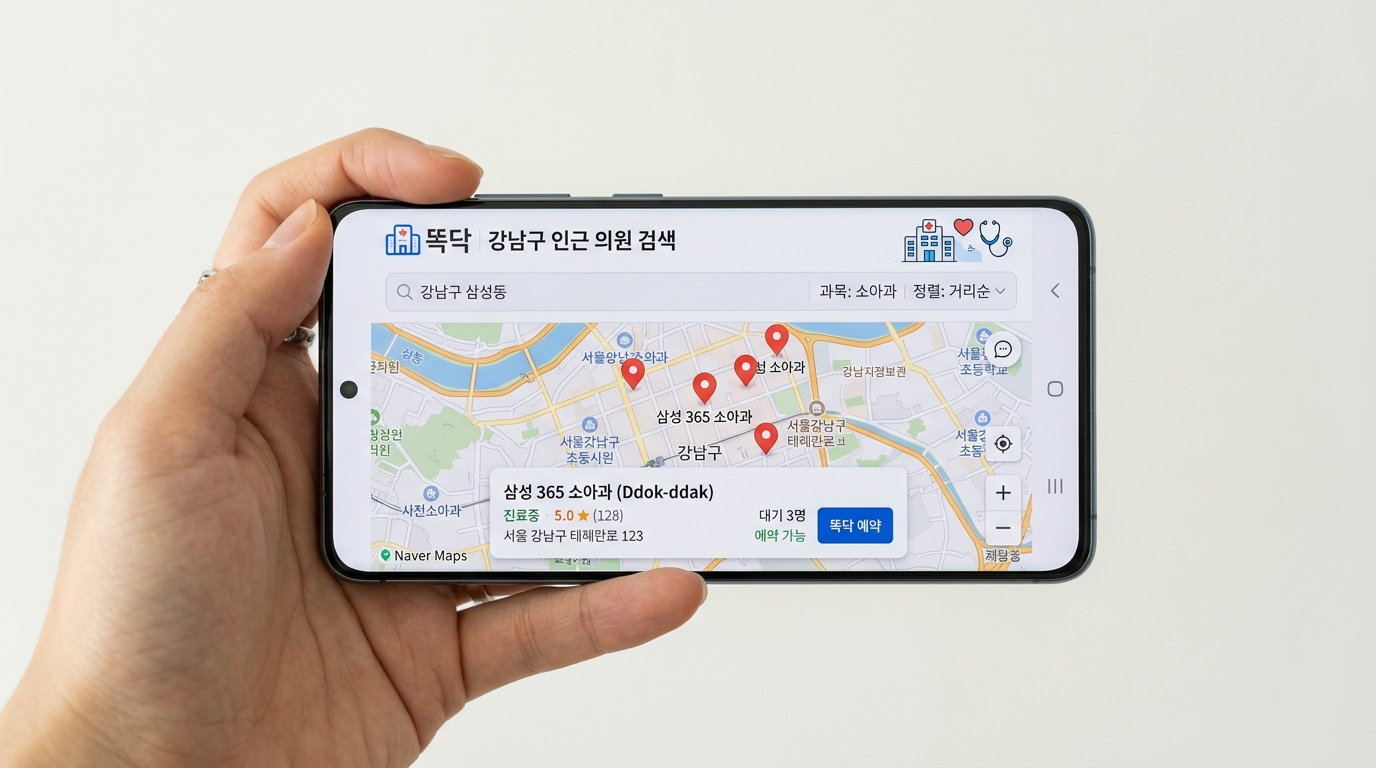
Instead of only searching “English hospital Seoul” on Google, try searching through Korean platforms as well. Apps and map services used by local residents often show more ordinary neighborhood clinics, which can be much more affordable for common issues such as colds, sore throats, stomach pain, skin problems, or minor injuries.
Useful search terms include:
- 영어 진료 — English consultation
- 외국인 진료 — foreigner treatment
- 내과 — internal medicine clinic
- 이비인후과 — ENT clinic
- 피부과 — dermatology clinic
You can also check the official National Health Insurance Service website here: NHIS – health insurance guidance for foreign residents.
2. Use Ddokdoc, Naver Map, and Papago Together
똑닥 (Ddokdoc) is commonly used in Korea for clinic search and appointment-related services, although available features may vary by clinic, region, and app update. Naver Map is also useful because it shows reviews, opening hours, location, and nearby pharmacies.
Before going to the clinic, prepare your symptoms in Papago. Keep the Korean translation ready on your phone so you can show it to the receptionist or doctor.
For example:
- 열이 나요. — I have a fever.
- 목이 아파요. — I have a sore throat.
- 기침이 나요. — I have a cough.
- 배가 아파요. — I have stomach pain.
- 어지러워요. — I feel dizzy.

3. Call the NHIS Hotline If You Need Help
If you are enrolled in Korean National Health Insurance, the NHIS foreign-language service can be a helpful starting point. You can call 1577-1000 and ask for foreign-language support. Available language options and service hours may change, so it is best to confirm through the official NHIS website.
When calling, you can ask:
- “Can you help me find a clinic near my area?”
- “Can I use National Health Insurance for this treatment?”
- “Where can I check my insurance qualification?”
This is especially useful if you are not sure whether your visa status, insurance status, or recent registration situation affects your medical costs.
4. Ask the Magic Question at Reception
Before you agree to treatment, ask this sentence clearly:
통역사 비용이 따로 있나요?
Tong-yeok-sa bi-yong-i dda-ro it-na-yo?
“Is there a separate interpreter fee?”
You can also ask:
추가 비용이 있나요?
Chu-ga bi-yong-i it-na-yo?
“Are there any additional fees?”
If the clinic says there is a separate fee, that does not automatically mean the clinic is bad. Some clinics provide professional interpretation or international patient services. The problem is not the fee itself. The problem is when the fee is not clearly explained before treatment.
Jin's 8282 Pro Tips
University Hospitals Are Usually More Structured
Large university hospitals such as Severance Hospital, Seoul National University Hospital, Samsung Medical Center, and Asan Medical Center often have international healthcare centers. These places are usually more structured for foreign patients, but they may also be slower, more expensive, and less convenient for simple symptoms.
For serious symptoms, complex tests, surgery, or specialist care, a major hospital may be the better option. For a simple cold or mild stomach issue, a neighborhood clinic may be enough.
Neighborhood Clinics Can Be Very Practical
For everyday health problems, a local 의원 (ui-won), meaning a small clinic, is often the most practical choice. Many doctors can understand basic English medical words, and with Papago prepared in advance, communication is often manageable.
Good signs to look for include:
- Clear reception process
- Many local Korean patients
- Reasonable waiting time
- Willingness to explain costs before treatment
- Nearby pharmacy after the visit
Always Ask for a Detailed Receipt
After your appointment, ask for a detailed receipt:
상세 영수증 주세요.
Sang-se yeong-su-jeung ju-se-yo.
“Please give me a detailed receipt.”
Check for words such as:
- 통역 — interpretation
- 상담 — consultation
- 코디네이터 — coordinator
- 비급여 — non-covered by national insurance
If you see a charge you do not understand, ask:
이건 뭐예요?
I-geon mwo-ye-yo?
“What is this?”
Common Mistakes Foreigners Make at Korean Clinics
Mistake 1: Choosing the Most Expensive Area First
Clinics in areas such as Gangnam, Apgujeong, Cheongdam, Myeongdong, or Hongdae may be convenient for foreigners, but some also target international customers with premium services. This is not always a problem, but you should compare options before assuming they are the best choice.
For basic medical care, a local clinic near your home, school, or workplace may be faster and more affordable.
Mistake 2: Agreeing to Optional Treatments Too Quickly
Some clinics may recommend optional treatments such as vitamin injections, IV drips, skin-related add-ons, or non-insured medicine. These may be useful in some cases, but they are not always necessary for common symptoms.
If you do not want extra treatment, you can simply say:
괜찮아요.
Gwaen-chan-a-yo.
“No, thank you.” / “I’m okay.”
You can also ask:
이거 꼭 해야 하나요?
I-geo kkok hae-ya ha-na-yo?
“Do I really need to do this?”
Mistake 3: Not Asking Whether the Treatment Is Covered by Insurance
In Korea, some treatments are covered by National Health Insurance, while others are 비급여, meaning non-covered. Non-covered services can be much more expensive.
Before receiving treatment, ask:
보험 적용되나요?
Bo-heom jeok-yong doe-na-yo?
“Is this covered by insurance?”
This question is especially important for injections, skin treatments, special tests, supplements, and optional procedures.
Mistake 4: Forgetting That the Pharmacy Is Separate
In Korea, clinics and pharmacies are usually separate. After the doctor gives you a prescription, you take it to a nearby pharmacy. The pharmacy cost depends on the medicine, insurance coverage, and whether the medicine is covered or non-covered.
If the price feels unexpectedly high, you can politely ask the pharmacist:
보험 적용 약인가요?
Bo-heom jeok-yong yak-in-ga-yo?
“Is this medicine covered by insurance?”

Useful Korean Phrases for Clinic Visits
- 예약했어요. — I made a reservation.
- 처음 왔어요. — This is my first visit.
- 외국인등록증 있어요. — I have an Alien Registration Card.
- 건강보험 있어요. — I have National Health Insurance.
- 영어 가능한 의사 선생님 계세요? — Is there a doctor who can speak English?
- 천천히 말씀해 주세요. — Please speak slowly.
- 종이에 써 주세요. — Please write it down.
- 비용이 얼마예요? — How much does it cost?
Bottom Line
Korean healthcare can be fast, professional, and surprisingly affordable when you know how to use the system. But as a foreigner, you should not rely only on English websites or premium-looking “global” branding.
Use Korean search tools, prepare your symptoms with Papago, check whether your treatment is covered by insurance, and always ask about extra interpreter or coordinator fees before treatment begins.
The most useful sentence to remember is:
통역사 비용이 따로 있나요?
“Is there a separate interpreter fee?”
A few seconds of asking can save you money, confusion, and stress.
If you are living in Korea and want more practical guides like this, check out more AllThingsK8282 articles on daily life, healthcare, apps, housing, and money tips for foreigners in Korea.


0 Comments