
The Struggle is Real: Your Hard-Earned Won vs. The World
Hey there, fellow Korea dweller! Welcome. You’ve made it. You’ve navigated the visa process, found an apartment, conquered the subway system, and maybe even figured out the difference between jjigae and tang. You’ve just received your first (or maybe your fiftieth) paycheck, and that beautiful string of zeros hits your Korean bank account. It’s a great feeling. You feel proud, accomplished. And then, the thought hits you: “I need to send some of this home.”
Suddenly, that feeling of accomplishment evaporates, replaced by a wave of anxiety. Welcome to one of the classic expat-in-Korea hurdles: the international money transfer. Your mind starts racing with questions. Do I have to go to a bank? Can I do it online? What’s a SWIFT code? Why does the bank teller look so confused when I ask about intermediary fees? You see ads for apps like Sentbe and Wise, but are they safe? Is it even legal? It feels like you need a degree in international finance just to pay off a student loan back home.
Believe me, we have all been there. Staring at a remittance form written entirely in Korean, sweating under the fluorescent lights of a bank, wondering if your money will ever make it to your family’s account or if it will simply vanish into the digital ether. The traditional banking system can feel opaque and intimidating, with hidden fees and exchange rates that seem to defy logic. On the other hand, trusting a flashy new app with thousands of your hard-earned won can feel like a leap of faith.
But take a deep breath. I’m here to tell you that in 2026, sending money home from Korea is easier, cheaper, and faster than ever before—if you know the rules of the game. This guide is your cheat sheet. We’re going to break it down, step-by-step, just like we’re sitting at a cafe over a well-deserved iced americano. No confusing jargon, no unnecessary steps. Just a clear, practical roadmap to becoming a remittance pro. Let’s get your money where it needs to go, without the headache.
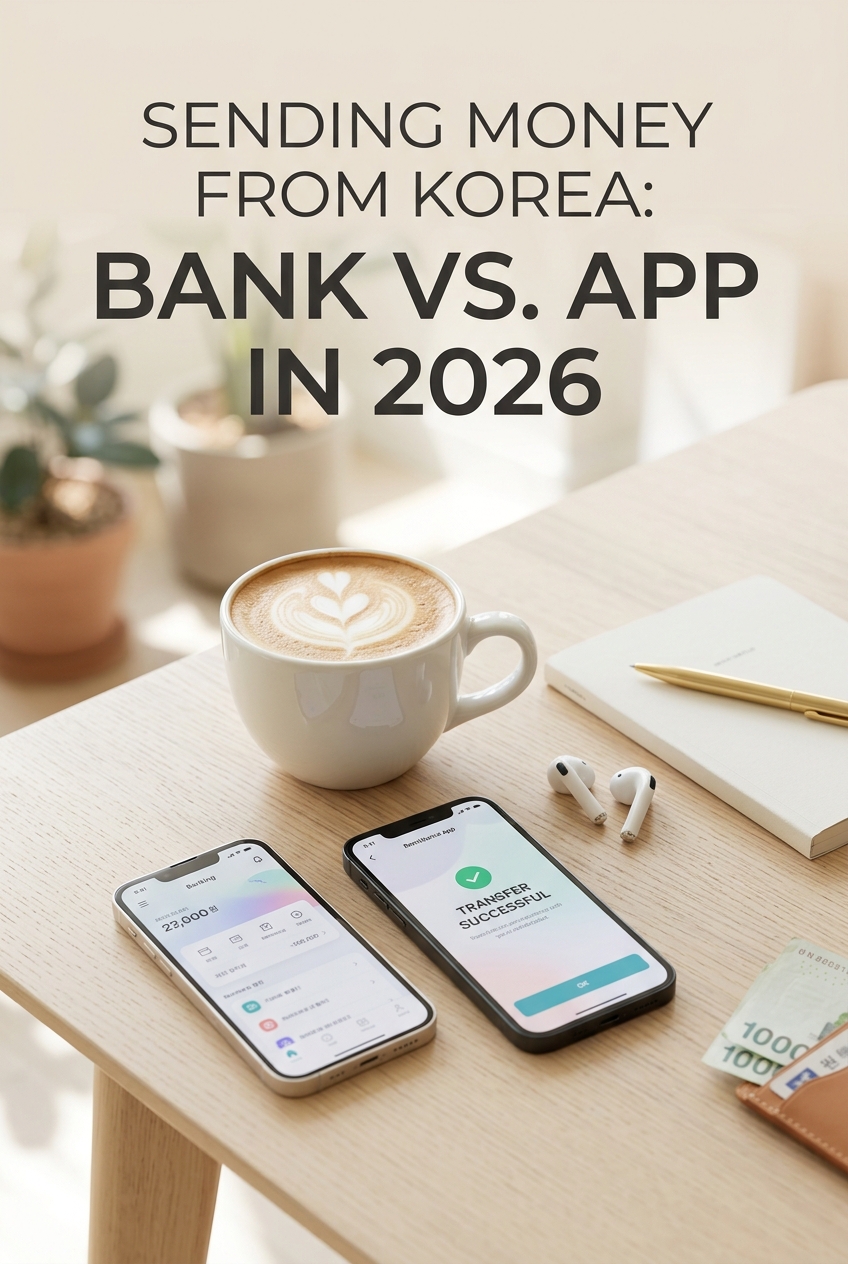
The Great Remittance Showdown: Banks vs. Fintech Apps in 2026
The choice boils down to two main paths: the traditional, sturdy bank transfer or the sleek, modern fintech app. Both have their place, and your choice depends on your needs—speed, cost, transfer amount, and your personal comfort level.
Part 1: The Traditional Bank Transfer (The "Old School" Reliable Method)
Going through your main Korean bank (like KB Kookmin, Shinhan, Woori, or KEB Hana) is the way our expat predecessors did it for decades. It feels official and secure, which is great peace of mind, especially for large amounts. This method is best if you're sending a very large sum (think a down payment on a house) or if you need official documentation from a major bank for tax purposes back home.
-
Step 1: Gather Your Documents & Information (The Prep Work)
Before you even think about heading to the bank, get your arsenal ready. You absolutely need:- Your Alien Registration Card (ARC). This is non-negotiable.
- Your Passport. Bring it just in case.
- Your Korean Bankbook (통장 - tongjang) or debit card for the account you're sending from.
- Recipient's Full Information (100% Correct!): This is where most errors happen. Get this information in writing from the recipient. You need their:
- Full legal name as it appears on their bank account.
- Full address.
- Bank's full name and address.
- SWIFT/BIC code: This is the international address for their bank. It's usually 8-11 characters long. Google "[Bank Name] SWIFT code" if they don't know it.
- Account Number: For Europe, this is often an IBAN. For the US, it's the account number and sometimes a routing number. Double-check!
-
Step 2: Set Up Your "Designated Bank" (A One-Time Task)
Here’s a crucial piece of Korean bureaucracy: for overseas remittances, you must register one bank as your primary remittance bank. This is called 지정거래 외국환은행 (jijeong-georae oeguk-hwan eun-haeng). You only have to do this once. You must do it in person at a branch. Walk in, take a number, and tell the teller you want to set up overseas remittance (해외송금 - hae-oe song-geum). They will have you fill out a form with your details and the recipient's details. Once this is set up, you can make future transfers to that same recipient via the bank's app. -
Step 3: Making the Transfer
You have two options here:- In-Person: Go to the teller and fill out the remittance request form, called a 해외송금 신청서 (hae-oe song-geum sin-cheong-seo). Hand it over with your ARC and bankbook. The teller will process it. If you're nervous about the language, have Papago ready on your phone to translate.
- Online/Mobile App: By 2026, every major bank's app (KB Star Banking, Shinhan SOL, etc.) has a functional overseas remittance section. Once you've done the in-person designation, you can log in, find the menu (usually under 외환/FX or Global Transfer), and follow the prompts. It's gotten much more user-friendly over the years, but can still be a bit clunky compared to the newer apps.
-
Step 4: Brace for the Fees
This is the bank's biggest downside. The cost is broken into three parts:- Sender's Fee (송금 수수료): A flat fee charged by your Korean bank, usually ₩5,000 - ₩15,000.
- Intermediary Bank Fee (중계은행 수수료): A fee charged by one or more banks that handle the transfer in the middle. This can be $15-$30 USD and is often deducted from the amount you send.
- Exchange Rate Margin: This is the hidden cost. The bank gives you an exchange rate that is worse than the real, mid-market rate. This difference is pure profit for them and can cost you a lot on larger transfers.
Part 2: The Fintech App Transfer (The Fast, Cheap & Easy Method)
Welcome to the future. For 95% of expats, services like Wise (formerly TransferWise) and Sentbe are the undisputed champions of remittance in 2026. They are built specifically for this purpose and blow banks out of the water on speed, cost, and convenience. They are fully licensed and regulated by the Korean government, so your money is safe.
-
Step 1: Choose Your Weapon
The two biggest players are Wise and Sentbe.- Wise: Known for its radical transparency. It always uses the real mid-market exchange rate (the one you see on Google) and charges a clear, upfront fee. It's fantastic for sending to a huge variety of countries worldwide.
- Sentbe: A Korean-based powerhouse that is often extremely competitive for sending money to other Asian countries (like the Philippines, Vietnam, Indonesia, etc.). They frequently run promotions with low or zero fees.
-
Step 2: The 10-Minute Verification
This is all done from your couch. No bank visit required. The process is standard for all apps due to KYC (Know Your Customer) laws:- Download the app and create an account.
- You'll be prompted to verify your identity. This usually involves taking a photo of your ARC (front and back) and a photo of your passport's information page.
- You'll also need to link your Korean bank account, which is a simple process of entering your account number.
-
Step 3: Send Money While Your Coffee Brews
This is where the magic happens. The process is beautifully simple:- Open the app and select "Send Money."
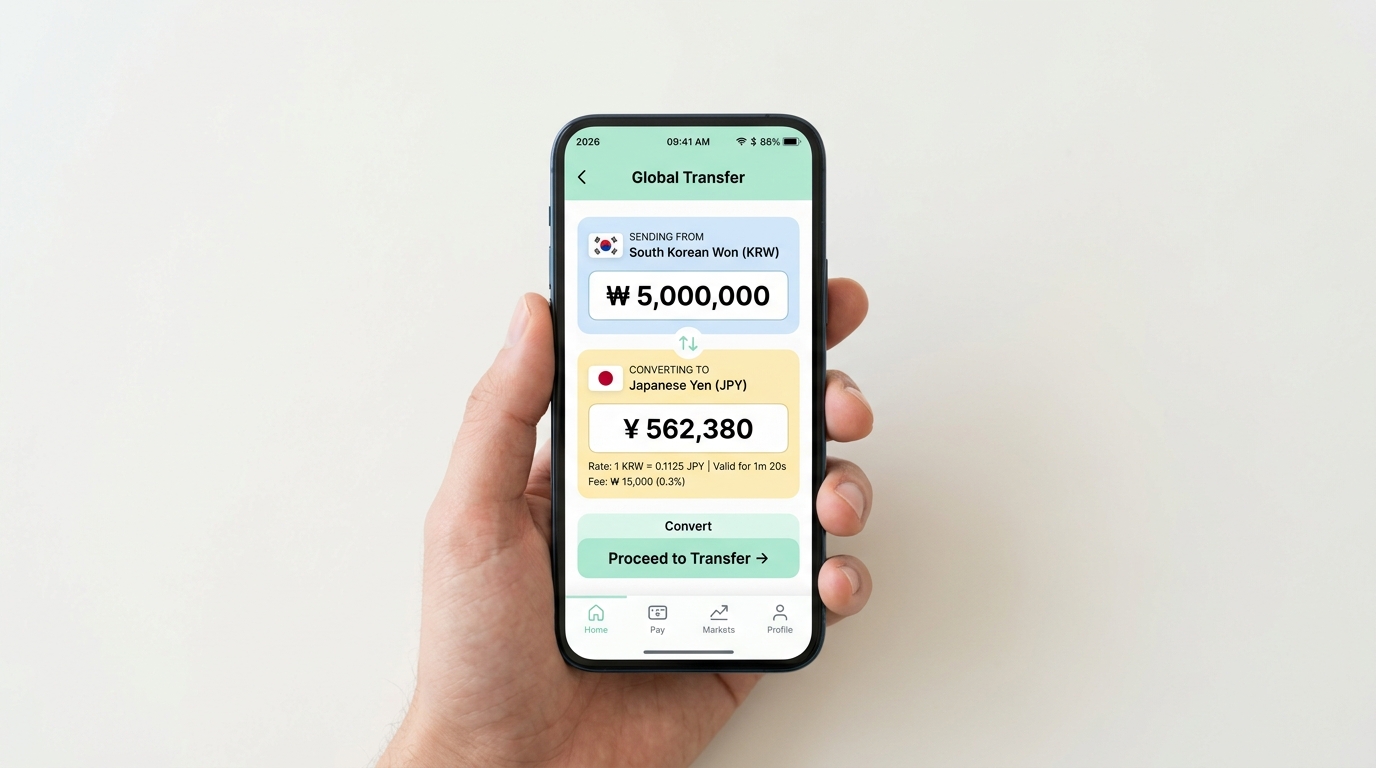
- Enter the amount in KRW you want to send, or the foreign currency amount you want your recipient to get. The app instantly shows you the exchange rate, the fee, and the final amount. No surprises.
- Select your recipient (you can add and save their bank details so you never have to type them in again).
- Confirm the transfer. The app will then show you a unique Virtual Bank Account (가상계좌 - gasang gyejwa).
- Open your regular Korean bank app (like Kakao Bank or KB), and make a simple domestic transfer of the exact KRW amount to that virtual account number.
- That's it! Once your domestic transfer is received (which is instant), the app takes over and sends the money internationally. You'll get notifications every step of the way, from "Money Received" to "Transfer Sent" to "Delivered." Many transfers arrive in hours, or even minutes.
-
Step 4: Know The Limits
For compliance reasons, these apps have limits. Typically, you can send up to ~$5,000 USD per transfer and a total of $50,000 USD per year without providing extra documents. If you need to send more than the annual limit, the app will prompt you to upload proof of income (like your employment contract or pay stubs), which is a simple and secure process.

Your Remittance Toolkit: Must-Have Apps & Tools for 2026
To make this process as smooth as possible, make sure you have these on your phone and in your wallet. They are the foundation of a stress-free financial life in Korea.
- Wise & Sentbe: These are your primary remittance tools. Having both allows you to compare rates in real-time and choose the most cost-effective option for each transfer. Think of them as your money-sending superstars.
- Kakao Bank or K-Bank: These internet-only banks have incredibly simple, clean user interfaces in English. They are perfect for the final step of funding your remittance app transfer. Sending money from Kakao Bank to the virtual account provided by Wise/Sentbe is a 30-second, hassle-free process.
- Your Main Bank's App (e.g., KB Star, Shinhan SOL): Even if you use an internet bank for daily life, you'll still need your primary bank's app. Your salary is likely deposited here, and you'll use it to transfer funds to your Kakao Bank or directly to a remittance service.
- Papago: This is your digital translator. It's far superior to Google Translate for Korean. Use the conversation mode if you need to speak with a teller, or the camera function to translate forms in real-time. It’s an absolute lifesaver.
- Your Physical ARC (Alien Registration Card): The key to everything. Always have it with you for any official bank business. Keep a high-quality photo of the front and back on your phone as well, as it's often needed for online verification.
- Digital Certificates (금융인증서/공동인증서): The infamous Public Key Certificate (공동인증서) is slowly being phased out, but its easier, cloud-based successor, the Financial Certificate (금융인증서), is now the standard for high-level security on banking apps. You'll set this up through your bank's app, and it allows you to authorize large transactions without a physical security card. Make sure yours is set up and working.
Common Mistakes to Avoid (Learn From My Errors!)
I’ve seen (and made) my fair share of mistakes over the years. Avoid these common pitfalls to save yourself time, money, and a whole lot of stress.
-
Mistake 1: Only Looking at the Transfer Fee.
A low fee is often a marketing trick to hide a terrible exchange rate. The single most important factor for cost is the exchange rate. A bank might offer a "₩5,000 Fee Special" but give you a rate of 1,350 KRW/USD when the real rate is 1,320. On a $1,000 transfer, that poor rate just cost you ₩30,000! Always compare the final amount the recipient will get, not just the advertised fee. -
Mistake 2: Typos in Recipient Details.
This is the #1 cause of failed or delayed transfers. Sending money to the wrong account is a nightmare. A single incorrect digit in an account number or a misspelled name can cause the transfer to bounce back days or weeks later, often with fees deducted. Copy and paste the information directly from a message from your recipient. Double-check. Then triple-check before you hit send. -
Mistake 3: Trying to Send from an Undesignated Bank.
If you're using the traditional bank method, you can't just walk into any bank to send money. You have to use the one you registered as your 지정거래 외국환은행. Trying to do it elsewhere will only lead to a polite but firm refusal from the bank teller. -
Mistake 4: Panicking About Annual Limits.
The $50,000 USD annual limit for undocumented transfers is not a hard wall. It's a regulatory checkpoint. If you're a salaried employee in Korea, you can easily prove your source of funds. If you need to send more, the bank or app will simply ask for a copy of your employment contract or income statement (근로소득 원천징수영수증). It’s a standard procedure, so don't be afraid of it. -
Mistake 5: Sending Money on a Friday Night.
Remember that banks have weekends and holidays. International transfers require banks in both your country and the recipient's country to be open. If you send money from Korea on a Friday evening, it won't even start processing until Monday morning in Korea, and it might be Sunday where it's going. For the fastest results, always initiate transfers between Monday and Thursday morning. -
Mistake 6: Using a Friend’s Bank Account to Send or Receive Money.
Never do this. Sending money from a Korean bank account that isn't in your name, or having a friend send it for you, can trigger anti-money laundering alerts. It creates a messy paper trail and can cause legal and financial complications for both of you. The name on the sending account must match the name on your remittance app profile.

Conclusion: You've Got This!
And there you have it. What once seemed like a daunting financial puzzle is now, hopefully, a clear and manageable task. The world of Korean banking and remittance has transformed for the better, and by 2026, the tools at our disposal are incredibly powerful.
The takeaway is simple: for the vast majority of your needs—sending money home for bills, savings, or family support—fintech apps like Wise and Sentbe are your new best friends. They offer a combination of transparency, low cost, and sheer convenience that traditional banks just can't match. For those rare, monumental life moments requiring a huge transfer, the bank is still a solid, reliable option that provides that extra layer of official documentation.
The first time you do it, it might feel a little strange. But after that first successful transfer, when you see the money land safely in your home account in a matter of hours, you'll feel a new level of confidence. You’ve unlocked another achievement in your Korean life. You’ve navigated the bureaucracy, embraced the technology, and taken control of your finances. So go ahead, make that transfer. You're more than ready.
🔗 Useful Resources for Your Next Remittance
Top-Rated Fintech Apps (Fast & Cheap)
: Best for mid-market exchange rates and transparency. Wise (formerly TransferWise) : Highly recommended for transfers within Asia with frequent zero-fee promotions. Sentbe (센트비) : A strong alternative with competitive rates for North America and Oceania. WireBarley (와이어바알리)
Major Korean Banks (English Portals)
: The most expat-friendly bank for currency exchange and designated remittance. Hana Bank Global FX : Official site for Shinhan SOL Global app users. Shinhan Bank Global : Detailed guide on international telegraphic transfers. KB Kookmin Bank English
Essential Tools & Documentation
: The gold standard for translating banking terms and forms accurately. Naver Papago Translator : Look up any Korean or international bank's SWIFT/BIC code. The SWIFT Codes Database : KOTRA's official English guide on the South Korean financial system for foreigners. Invest Korea - Banking Guide
Official Regulatory Info
: The primary portal for all things related to your ARC and legal stay. Hi Korea (Government Guide) : Information on foreign exchange transaction laws (Foreign Exchange Transactions Act). Financial Supervisory Service (FSS)


0 Comments