
Korea SIM vs Pocket WiFi vs eSIM: The Ultimate 2026 Guide to Staying Connected in Seoul (Don't Make This Mistake!)
Alright, let's have some real talk. You've booked your ticket to South Korea. You've binge-watched every K-drama imaginable, your stomach is already rumbling for Korean BBQ, and you’ve mentally prepared yourself for the sheer awesome that is Seoul. But hold up. Before you even think about packing, we need to discuss the single most important tool in your travel arsenal, the one thing that will make or break your trip: staying connected.
I’m not being dramatic. This isn't like a trip to Italy where you can 'get lost in the charming streets' and it's romantic. In Korea, getting lost means staring blankly at a bus sign written entirely in Hangul while your phone, a useless brick without data, mocks you from your pocket. South Korea isn't just technologically advanced; it's a country that *runs* on data. From navigating the sprawling subway to ordering a coffee or finding that hidden, life-changing kimchi jjigae spot, your digital lifeline is everything. Forget it, and you’re basically traveling in black and white while everyone else is in glorious 4K.
For years, I’ve been hopping on that 14-hour flight to my soul-city, Seoul, and I've tried it all. The clunky pocket WiFi, the classic tourist SIM, and the new kid on the block, the eSIM. I’ve made the mistakes so you don’t have to. So grab a cup of coffee (or a banana milk, if you're already in the spirit), and let’s dive deep into the great connectivity debate of 2026. This is your definitive guide to choosing the right option for *your* adventure.

First Things First: How to Get Connected the Second You Land
Your journey into hyper-connectivity begins at Incheon International Airport (ICN), which, by the way, is so efficient and clean it feels like an airport from the year 2050. Forget fumbling around in the city looking for a phone store. The magic happens the moment you clear customs.
As you walk into the arrivals hall, you'll see them: bright, welcoming booths for Korea's 'Big Three' telecom giants – KT, SK Telecom, and LG U+. My advice? Pre-book online before your flight. Seriously. You’ll almost always get a discount, and it saves you the hassle of decision-making when you're jet-lagged. You just waltz up to the counter, show them your email voucher, and you’re handed your device or SIM card in minutes. It's a beautifully streamlined process.
Your Transit BFFs: T-Money & Naver Maps
Now, why is getting data at the airport so critical? Two words: Naver Map. Listen to me carefully: Google Maps does not work properly in South Korea. I repeat, DO NOT rely on Google Maps for walking or driving directions. Due to local regulations, it’s severely limited. You need Naver Map or Kakao Maps, both of which require a data connection. The moment you have your data sorted, download Naver Map. It’s the key to unlocking the entire country.
Your next move is to buy a T-money card. You can get these from any convenience store (GS25, CU, 7-Eleven) inside the airport. This is your rechargeable transit card for subways, buses, and even taxis. Having data means you can use the T-money app to track your balance, but the physical card is king. Load it up with about ₩20,000 to start, and you're golden.
From Incheon, you have two main train options to get to Seoul:
- AREX Express Train: This goes directly to Seoul Station in about 45 minutes. It’s faster, more comfortable, and has assigned seating.
- AREX All-Stop Train: This is the commuter line. It takes about 60-70 minutes to Seoul Station but makes stops along the way, which might be more convenient depending on where your accommodation is (e.g., Hongdae).
With your data flowing and Naver Map guiding you, you'll be navigating the world-class subway system like a seasoned local from the get-go. No stress, just pure adventure.

The Great Connectivity Showdown: An Honest Review of Your Options
Okay, this is the main event. SIM, Pocket WiFi, or eSIM? Each has its tribe, and what's perfect for a solo backpacker might be a nightmare for a family of four. Let's break it down, no fluff.
Option 1: The Physical SIM Card (The Old Faithful)
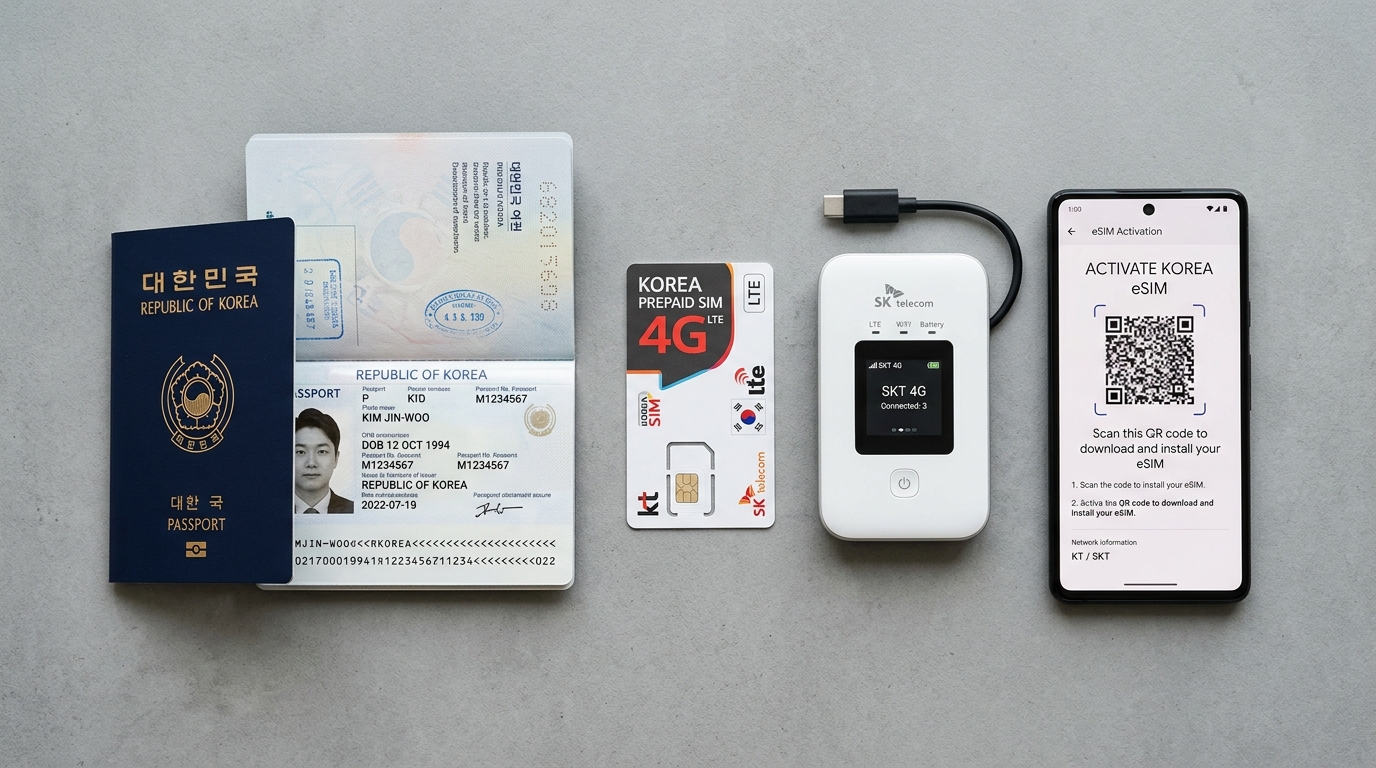
This is the classic choice. You get a small piece of plastic, pop open your phone's SIM tray with that little pin you can never find, and replace your home SIM with a Korean one. Voila, you have a Korean phone number and a direct line to that sweet, sweet 5G network.
What to Expect: The process is simple. You'll likely get a card with a breakaway design to fit any phone (nano, micro, etc.). Once it's in, you might need a quick restart, and you're online. Speeds are phenomenal – we're talking downloading a full Netflix episode in the time it takes to tie your shoes. Most plans offer 'unlimited data', which usually means a massive daily allowance of high-speed data (like 3-5GB per day) and then throttled, but still usable, speeds after that. Trust me, it's more than enough.
- The Best Parts: You get a Korean phone number (010-XXXX-XXXX). This is surprisingly useful for things like making restaurant reservations or using local delivery apps, which have become way more English-friendly in 2026. It's a reliable, set-it-and-forget-it solution. Your phone just *works*.
- The Annoying Parts: You have to perform minor surgery on your phone. The biggest risk is losing your tiny home SIM card. I recommend taping it inside your phone case or putting it in a labeled corner of your wallet immediately. Also, if your phone is 'locked' to your home carrier, a Korean SIM won't work. Make sure your phone is unlocked before you leave!
- Verdict: Perfect for solo travelers, couples who want their own independent connections, and anyone staying for more than a week. The convenience of having a local number is a game-changer.
Option 2: The Pocket WiFi / WiFi Egg (The Group Hero)
This is a small, portable modem that fits in your palm. You turn it on, it connects to the cellular network, and then it broadcasts a private WiFi signal that you and your friends can connect to. It's like carrying your own personal internet bubble around.
What to Expect: You'll be handed a small device (the 'egg') and a charger. You connect to it just like any other WiFi network with a password they provide. It's super easy to share the connection with your travel companions and all your devices (laptop, tablet, etc.).
- The Best Parts: Cost-effective for groups. Instead of everyone buying a SIM card, one person can rent a Pocket WiFi and split the cost. It's a lifesaver if you have multiple devices you need to get online, like a work laptop.
- The Annoying Parts: It's another thing to carry and another thing to charge every single night. The battery life on the 2026 models is decent, usually lasting a full day, but if you forget to charge it, your whole group is offline. The other major downside? The leash. You have to stay within about 10-15 meters of the person carrying the egg. If your group splits up to go to different shops, someone is getting left in the digital dark.
- Verdict: Ideal for families with kids or groups that plan to stick together 99% of the time. If you're a digital nomad working from cafes, it's also a solid choice for connecting your laptop.
Option 3: The eSIM (The Future, Now)
The eSIM (embedded SIM) is a digital SIM card. There's nothing to physically swap. You typically get a QR code via email, scan it with your phone's camera, follow a few on-screen prompts, and boom – your phone is connected. It's pure magic.
What to Expect: The setup is done entirely on your phone. It's incredibly fast, often taking less than five minutes. You can even buy and install it while you're on the plane, so you're connected the moment the wheels touch down. Your phone can hold multiple eSIM profiles, so you can switch between your home plan and your Korea plan with a tap.
- The Best Parts: Unbeatable convenience. No fumbling with tiny SIM cards. You get to keep your home number active for receiving calls or texts (though check your carrier's roaming charges!). It's also more secure, as it can't be physically removed if your phone is lost. By 2026, compatibility is no longer a major issue; virtually all flagship phones from the last 3-4 years support it.
- The Annoying Parts: Most tourist eSIMs are data-only, meaning you won't get a Korean phone number. This is a deal-breaker for some. The setup, while easy for most, can feel a bit abstract and intimidating if you're not tech-savvy. You MUST double-check that your specific phone model is eSIM compatible and unlocked before purchasing.
- Verdict: The ultimate choice for tech-savvy travelers, short-term tourists, and anyone who values convenience above all else. If you don't need a local number, this is hands-down the slickest, most modern option available.
Your Secret Weapon for Conquering Korea's Food Scene
Now, let's talk about the *real* reason we're all here: the food. Having constant, high-speed data doesn't just help you get around; it transforms you into a culinary super-spy, capable of uncovering the most delicious, authentic food imaginable.
Forget tourist-trap restaurants. With your phone, you are armed with the tools the locals use. Your primary weapon is Naver Map. Unlike Google, Naver is packed with user reviews, photos, and ratings for everything. Here's how you use it to find a *matjip* (맛집), a certified delicious restaurant:
- Open Naver Map and type in the Korean food you're craving. Don't know how to type in Hangul? Use the Papago app (Korea's superior translation app) to translate 'pork belly' to '삼겹살' (samgyeopsal) and copy-paste it.
- Hit search. You'll see a map dotted with restaurants. Look for the ones with a high number of reviews (I'm talking hundreds, even thousands).
- Tap on a promising spot. You won't be able to read the reviews, but you can see the user-submitted photos. If you see pictures of locals happily grilling meat, long lines out the door, and dozens of photos of the same incredible-looking dish, you've found gold.
This is how you find the places that don't have English menus or signs. And when you get there? Use Papago's camera function to instantly translate the menu. You can confidently point and say 'Igeo juseyo!' (This one, please!) like a pro. This strategy has led me to the best *ganjang gejang* (soy-marinated raw crab) of my life in a tiny alley I would never have found otherwise.
It's the same for Korea's legendary cafe culture. Want to find that minimalist, aesthetic cafe you saw on Instagram in Seongsu-dong? Search for '성수동 카페' (Seongsu-dong cafe) and let the photo reviews guide you to your perfect cup of coffee and your next viral post. Your data connection is your passport to the authentic flavors of Korea.
The Vibe: The Feeling of Limitless Digital Freedom
Close your eyes for a second. I want you to imagine something. You're standing in the middle of the Myeongdong night market. The air is electric, thick with the sizzle of tteokbokki and the cheerful calls of vendors. Neon signs paint the crowd in vibrant strokes of red, blue, and green. It's a beautiful, overwhelming chaos.
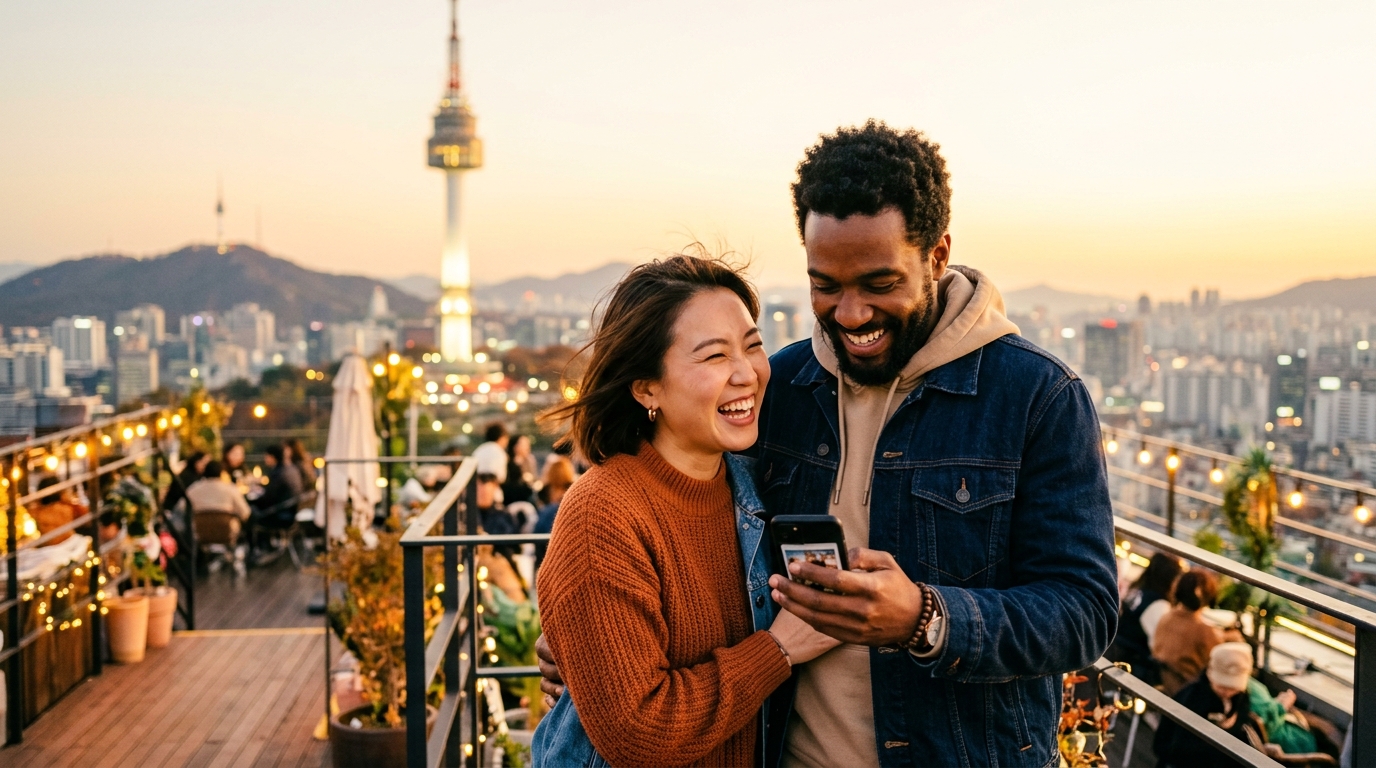
Now, imagine doing this without a safety net. It's stressful. But with that seamless 5G connection humming in your pocket? It's a different world. It’s the feeling of pure, unadulterated confidence. It’s the vibe of being a protagonist, not a lost tourist.
It’s the quiet *beep* of your T-money card as you breeze through the subway gates, your phone already displaying the fastest route to your next destination. It's the thrill of seeing a K-pop idol busking in Hongdae and being able to FaceTime your best friend back home instantly, the video crystal clear, sharing the moment across continents. It's the simple peace of mind of sitting in a gorgeous, traditional teahouse in Insadong, looking up the history of the palace you just visited, the information loading before you can even blink.
This is the sensory experience of being connected in Korea. It isn't about the tech itself. It’s about the freedom the tech gives you. It dissolves the language barrier, erases the fear of getting lost, and opens up a layer of the country that remains hidden to the unprepared. It allows you to be fully present in the moment, to soak in the sounds and smells and sights, knowing that all the information you could ever need is right there at your fingertips. It’s the silent, invisible superpower that makes a great trip an absolutely unforgettable one.
So, What's the Move?
In the end, there's no single 'best' choice – only the best choice for *you*.
- If you're a solo adventurer who wants a local number for all possibilities, go for the Physical SIM Card.
- If you're traveling with your family or a squad that sticks together, the Pocket WiFi is your budget-friendly best friend.
- And if you're a modern traveler who values speed and convenience above all, the eSIM is your clear winner.
No matter what you choose, do it before you go. Book it online. Arrive prepared. Because in a country as dynamic and digitally woven as South Korea, being connected isn't a luxury; it's the key that unlocks the entire kingdom. You’re not just buying data; you're buying a smoother, richer, and more authentic travel experience.
Now I want to hear from you! Which option are you leaning towards for your grand Korean adventure? Team SIM, Pocket WiFi, or eSIM? Drop your choice in the comments below!


0 Comments